Starward Observatory

Astronomy news

NASA

Webb helps trace a stellar merger in Andromeda

After a star spiralled into its supergiant companion, Webb observed the aftermath in infrared. Combined with earlier observations, the data let astronomers follow the system from before the 2025 eruption to the expanding dust left by the merger.

Read the NASA release
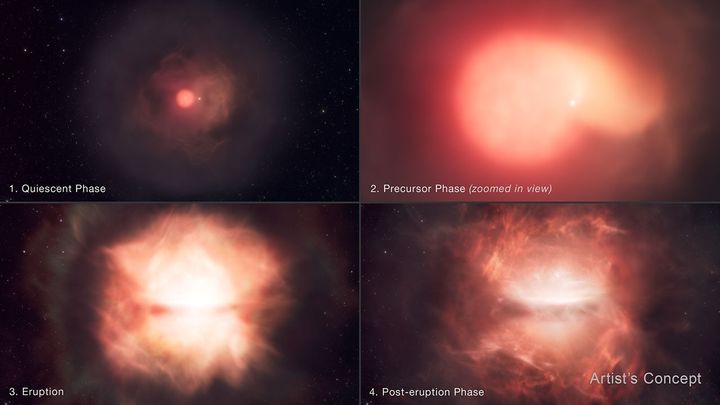
Artist’s concept showing two stars before, during and after their merger in four panels.
Illustration: NASA, ESA, CSA, STScI, Leah Hustak (STScI); Science: Viraj Karambelkar (Columbia)

More news

ESA Operations

BepiColombo reaches Mercury orbit

ESA confirmed that the joint European–Japanese mission was captured into orbit around Mercury on 21 November. A software issue cut the engine burn short. The spacecraft is safe, and the flight team is investigating.

Read the ESA mission update

NASA

Voyager 1 reaches one light-day from Earth

Voyager 1 passed the milestone on 18 November, about 26 billion kilometres from Earth. A radio signal takes roughly 24 hours to travel each way, so a command and its reply take about two days in transit.

Read the NASA release

NASA

Stratospheric dust holds clues to ice beyond Neptune

Researchers examined 12 dust grains collected high above Earth. Minerals in the grains carry a signature consistent with ancient water rich in heavier oxygen isotopes, offering clues to the ice that once existed in the Kuiper Belt.

Read the NASA report

ESA

Euclid releases the foundation for its 3D map

Euclid’s first major data release covers more than a billion objects and draws on about 13 months of observations. It gives researchers a starting point for charting the large-scale structure of the universe.

Read the ESA release

STScI

Hubble traces missing oxygen in dwarf galaxies

A study of 37 nearby dwarf galaxies found that they retain only a small share of the oxygen their stars produced. Winds driven by massive stars and supernovae may have carried much of it beyond the galaxies.

Read the STScI release

Research paper

Rubin spots two asteroids trailing Neptune

Observations from the Vera C. Rubin Observatory revealed two asteroids in stable orbits roughly 60° behind Neptune along its path around the Sun. The finds double the number of confirmed long-term members of that group from two to four.

Read the paper on arXiv

ESO

Two debris rings circle a white dwarf

Observations from ESO’s Very Large Telescope reveal two rings separated by a gap around the white dwarf J1328−1450. The research team proposes that surviving planetary bodies could account for the gap.

Read the ESO release